Showing posts with label analytics. Show all posts

Thursday, September 27, 2007

Rethink Web Analytics: Introducing Web Analytics 2.0

19 Sep 2007 12:29 am

gorgeousOn Sept 5th I had the distinct pleasure of being invited to present as a part of the Authors@Google series. As the author of a new book it was such a thrill to be invited, especially when you look at impressive authors who have been invited (some of my favorites: Seth Godin, George Soros, David Brooks, Ben Cohen, Clotilde Dusoulier).

The title of my talk was: Redefining Web Analytics.

The presentation covered the back story about my book, Web Analytics: An Hour A Day, the back story about why traditional web analytics finds itself in a pickle and presented my vision, definition and outline of Web Analytics 2.0.

I had presented the idea of Web Analytics 2.0 in the Achieving Marketing ROI Online workshop series in July. But it took the invite from the Authors@Google to get me to formalize it and present the details of what the big hub hub was all about.

Before we do anything else, here is a formal definition:

Web Analytics 2.0 is:

(1) the analysis of qualitative and quantitative data from your website and the competition,
(2) to drive a continual improvement of the online experience that your customers, and potential customers have,
(3) which translates into your desired outcomes.

Wordy? Yes. Bland? No. Could mean anything or everything? No. Specific & direct? Yes.

Hopefully you’ll agree (I absolutely welcome suggested improvements, especially from all you with a Masters in English!).

Here’s the delightful video:


(YouTube: Authors@Google: Avinash Kaushik)

For those of you who would like to skip forward and go directly to what interests you:

  • The book’s back story: 00:00 - 09:30 (mm:ss)

  • Why is web analytics in a “soup”: 09:30 - 18:00

  • Introducing Web Analytics 2.0: 18:00 - 20:00

  • Specifying the Web Analytics 2.0 mindset: 20:00 - 39:30

  • Lots of work? Expensive? Priorities?: 39:30 - 42:00

  • Interesting Q&A with Googlers: 42:00 - 55:55

Here in higher resolution is Web Analytics 1.0:

web analytics 1

You’ll have to watch the video to learn what that little circle is (I think you know what it is but you don’t want to admit it!!! :)).

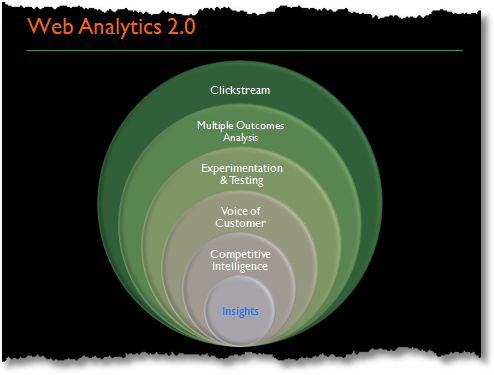
Here in higher resolution is Web Analytics 2.0:
web analytics 2

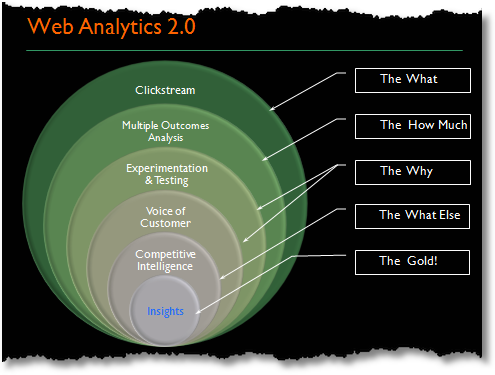
Each circle representing a key component of what your web analytics strategy should be, regardless of what your size is. Each circle also approximately represents the amount of data that you’ll have access to as you try to find insights / correlations.

Can Web Analytics 2.0 be explained in plain English? What are you solving for here? Yes……
web analytics 2

It is not enough to simple pontificate randomly about a vision or a new methodology. People demand specific details!! :) Absolutely - if you have not already then please consider watching minute twenty through minute thirty nine of the video were practical real life examples were presented to help you understand exactly what each component entails (for example what does “multiple outcomes analysis” mean in a Web Analytics 2.0 context?).

After that segment of the video you’ll learn exactly what you need to do to fill out the missing components to ensure you are executing with 2.0 in mind and not still in the world of 1.0.

I want to assure you that while this might seem a lot, it is not. It does not have to be expensive. It does not have to all happen overnight. You can start small, you can start cheap/free, you can start tomorrow morning.

think different web analytics 2

What is critical is that you “get” the mindset and that you have enough details to get going. At approximately minute 40 in the video I even provide a prioritized (rank ordered) execution strategy for you.

I cherish and value the readers of my blog more than any audience in the world! So just for you all I have cooked up something extra special that was not a part of the original presentation….

The big challenge for crossing any chasm, like this one, is not technology or tools or other related items. It is mindset. It is entrenched mindsets. For me and you and all of us the challenge will be to evolve our mindset to think 2.0. Here is the mindset evolution that is absolutely required if you are to move yourself / your organization to Web Analytics 2.0:

web analytics 2

In the world of Web Analytics 2.0 clicks don’t rule rather it is the combination of the “head and the heart” where you care just as much about what is happening on your website as you do about your competitor’s all the while automating as much decision making as you can so you eliminate reporting and even to some extent some analysis. Your world is one of continuous actions (surveys, testing, behavior targeting, keyword optimization…) and continuous improvements where Customers rule and not HiPPO’s.

[I am sure you have also noticed my riff of the iconic Apple Think Different campaign in the image above - Apple used Einstein, Muhammed Ali, Pablo Picasso and others, I could not think of anyone in our context more iconic to honor than Jim Sterne.]

Here’s something that inspires me, and hopefully you as you take on this 2.0 evolution, the text of the Think Different campaign:

Here’s to the crazy ones.
The misfits.
The rebels.
The troublemakers.
The round pegs in the square holes.
The ones who see things differently.
They’re not fond of rules.
And they have no respect for the status quo.
You can quote them, disagree with them, glorify or vilify them.
About the only thing you can’t do is ignore them.
Because they change things.

Tuesday, June 26, 2007

R/GA Names Kohnke For Data Intelligence

Tuesday, Jun 26, 2007 6:00 AM ET
R/GA HAS APPOINTED LUANE KOHNKE as managing director of data intelligence. In her new role, Kohnke's mission is to grow R/GA's analytics and Web-measurement practices, as well as augment them with customer-segmentation and data-driven targeting. She will also work on creating proprietary data-visualization and optimization tools. Kohnke, who most recently served as senior vice president, strategic services at Wunderman New York, will now head a team of analysts in New York and build an analytics team for R/GA in London.

Tuesday, June 19, 2007

Ad firms look for better gauge of success

CANNES, France — While the global ad industry is again gathered here to honor ad creativity, much of the talk at the 54th Cannes Lions International Advertising Festival is about number-crunching.

New media, as well as audience fragmentation, have upset the old agency model of creating ads and taking a percentage of the mass media spending as compensation. Today, there is pressure on agencies by marketers for new measures of the effectiveness of the $600 billion a year they spend worldwide on advertising, and agencies are trying to come up with models for being paid for that analytical work.

"Since every dollar has to work harder, clients are asking agencies to provide better predictors of success," says Anne Benvenuto, executive vice president, strategic services for digital agency R/GA.

But such predictors and pay models are all over the map. Particularly with fragmented new media, audience size often isn't high enough for statistically valid measures, and few standards for how to pay are in place.

"Digital and some of the emerging technologies don't have the reach and scale that TV has had," says Neil Canter, who heads Marketing Accountability Partnership, a division created at ad holding company Interpublic Group two years ago as a third-party ad measurement group. "So there are not very good inputs to the model. If you're going to figure this into compensation, you have to have an agreed-upon yardstick."

That yardstick is still up for grabs. Nielsen has only recently begun measuring commercial viewing, and the Internet Advertising Bureau is trying to establish standardized measures of Internet traffic.

"The name of the game for advertisers is using technology to document the effectiveness of ads," says David Evans, managing director of global competition policy at Massachusetts Institute of Technology and author of Catalyst Code: The Strategies Behind the World's Most Dynamic Companies. Evans says successful agencies will use analytical tools to measure the impact of ad ideas on sales and attitudes.

New measures and pay plans:

•Flat fees. Simplest is a negotiated fee for service based on costs and profit margins to measure an ad's effectiveness across media. Depending on the scale and scope of a project, marketers can pay anywhere from $35,000 to $1 million to apply analytical tools to optimize how and where ad dollars are placed.

Agency MindShare uses flat fees and sometimes the additional cost of a specialized manager to interpret data. "We're open to more fee-based agreements that reflect the exact scope of services for the advertisers," says Scott Neslund, CEO, MindShare North America. "To do a commission basis like … 20 years ago doesn't make sense."

•Dollars for consumer behavior. Direct-marketing agency Wunderman recently redefined some key measures to assign a dollar ratio to consumer actions, such as what percentage of visitors to a website performed a specified activity, such as requesting more information. "This is very, very meaningful for a client because it shows the value of a series of actions," says Mark Taylor, Wunderman's chief operating officer.

•Performance commission. DraftFCB, created last year by merging direct ad agency Draft and traditional agency FCB, created a variable-pay model based on a marketer's objectives. The agency still reaps a percentage of ad spending but will charge lower commissions in combination with a bonus if the program beats expectations.

"We want to compete the way clients do, which is based on performance measures," says Laurence Boschetto, president and chief operating officer. Real-time results for marketing programs are posted in the office on computer screens known as the "smart wall."

•Premium services. IPG's Marketing Accountability Partnership bills clients an average daily rate akin to consulting fees. Operating the unit independently of the agencies that create ads helps create the perception of objectivity and reduces the inclination for agencies to place ads in more costly media. "One of the key issues with accountability into compensation plans is the client perception of the objectivity of the accountability measures," MAP's Canter says.

Still, the industry hasn't moved as quickly as media has changed, and agencies are reluctant to give up commissions as a business model. And they don't want to be penalized if sales fall short for reasons other than the marketing.